The Sugar Pill That Keeps Winning
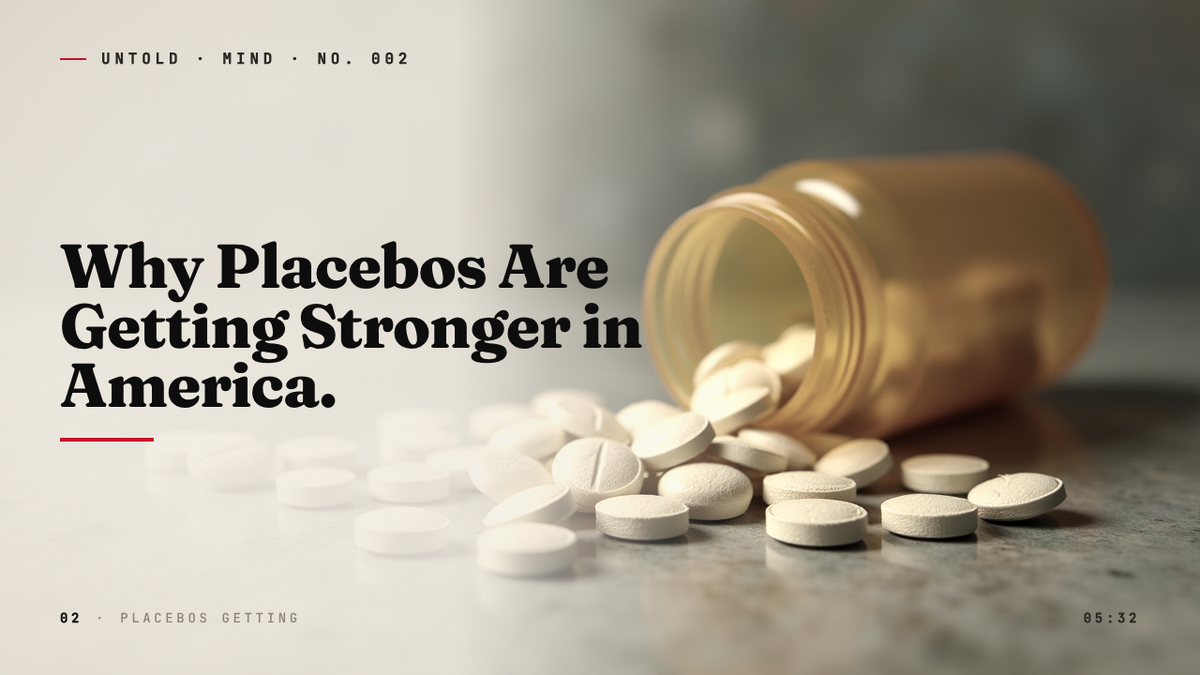
American placebos have grown so potent they are quietly bankrupting drug development.
In a beach-head field hospital at Anzio in the winter of 1944, an Army anesthesiologist named Henry Beecher ran out of morphine. The Allied landing on the Italian coast had produced more wounded than anyone had supplies for, and Beecher faced a problem that surgical textbooks did not address: how to operate on a man whose nerves were screaming without anything to quiet them. According to the story he would tell for the rest of his life, a nurse improvised. She drew up saline, injected it into a soldier’s arm with the brisk authority of someone administering opiate, and told him it was morphine. The man’s pain receded. He did not slide into shock on the table. Beecher, watching, began to suspect that something about the ritual of being treated — the needle, the nurse, the assurance — was itself doing pharmacological work.1
He spent the next decade trying to prove it. In 1955, now a Harvard professor, Beecher published a paper in The Journal of the American Medical Association called “The Powerful Placebo,” surveying fifteen clinical trials and arguing that roughly a third of patients responded to inert treatments across conditions as varied as postoperative pain, cough, and seasickness.2 The paper’s methods have since been criticized — Beecher conflated several phenomena that statisticians now separate — but its cultural effect was permanent. The Food and Drug Administration, then in the middle of designing the regulatory regime that would govern American pharmaceuticals for the rest of the century, adopted the placebo-controlled trial as the gold standard. Every new drug, from antidepressants to anti-inflammatories, would have to prove itself superior not just to nothing, but to the sugar pill that pretended to be something.
For several decades, this worked. Drugs won. Placebos lost. The system that Beecher had midwifed produced the largest pharmacopeia in human history. And then, sometime around the mid-1990s, the sugar pill started winning more often. Late-stage trials of perfectly serviceable compounds began to collapse — not because the drugs had stopped working, but because the placebos had gotten stronger. The phenomenon is now well documented, particularly in American trials, and it has quietly become one of the most expensive problems in medicine. It has also forced a reckoning with a question that Beecher only began to ask: what, exactly, is the placebo effect a measurement of?
A Word Borrowed From Funerals
The word placebo is Latin for “I shall please,” and its earliest medical use was disparaging. In the Middle Ages, hired mourners would chant the opening line of the Vespers for the Dead — Placebo Domino in regione vivorum — at funerals where the deceased’s family wanted a larger turnout than grief alone could supply. By the eighteenth century, English physicians had repurposed the term for any treatment given to satisfy a patient rather than cure him. The 1811 Hooper’s Medical Dictionary defined a placebo as “an epithet given to any medicine adapted more to please than benefit the patient.” The implication was unambiguous: a real doctor used real medicine, and the placebo was a courtesy extended to the terminally hopeless or the chronically demanding.3
What Beecher’s wartime experience suggested — and what later researchers would confirm with imaging tools he could not have imagined — was that this hierarchy had the situation backwards. The placebo was not a substitute for pharmacology. It was pharmacology, conducted by the patient’s own body, triggered by cues the patient might not even consciously register. The pill, the lab coat, the unhurried examination, the act of being taken seriously — these were not the wrapping around the medicine. In a meaningful share of cases, they were the medicine.
This was a difficult idea for twentieth-century medicine to absorb, because it implied that the doctor’s manner was a quantifiable variable, on a continuum with dosage and half-life. It also implied that the placebo response was not a single thing but a constellation of overlapping mechanisms — expectation, classical conditioning, anxiety reduction, the social warmth of being attended to. Disentangling them would become the work of the next half century.
The Trials That Stopped Working
In the mid-1990s, William Potter, a neuroscientist who had spent most of his career at the National Institute of Mental Health before joining Eli Lilly, began to notice a pattern he could not explain. Antidepressants that had performed well in earlier trials were now failing in late-stage studies, not because patients on the active drug were doing worse, but because patients on the placebo were doing better. The compounds had not changed. The trial design had not, on paper, changed. Something else had.4
Potter’s observation, which he would later describe to The New Yorker’s Steve Silberman, was not idiosyncratic. By the early 2000s, multiple pharmaceutical companies had quietly scrapped promising drug programs because the molecules could not separate themselves statistically from inert pills. The problem was particularly acute in psychiatry and pain medicine, the two fields most reliant on patient self-report. Average placebo response rates in American antidepressant trials, which had hovered around 30 percent in the 1980s, climbed past 40 percent by the 2010s.5 Drugs that would have sailed through approval in 1985 now drowned in their own control arms.
The most striking documentation came from Jeffrey Mogil, a pain researcher at McGill University. In 2015, Mogil’s group published a meta-analysis in the journal Pain examining 84 clinical trials of medications for chronic neuropathic pain conducted between 1990 and 2013. The active drugs had not become less effective over time. The placebos, however, had become dramatically more so. In 1996, the average difference between drug and placebo in these trials was about 27 percent. By 2013, it had narrowed to 9 percent. And the trend was almost entirely confined to one country.6
Why the Effect Stops at the Border
Mogil’s most provocative finding was geographic. The placebo response had risen sharply in American trials and barely budged elsewhere. European, Asian, and Australian studies of the same drug classes, often using the same protocols, showed stable placebo arms across the same two decades. Something about the American medical environment was teaching patients to respond more powerfully to inert treatment, and his team set out to figure out what.
The most plausible explanations clustered around the architecture of the trials themselves. American studies had grown in scale and ambition over the period in question. They lasted longer, enrolled more participants, deployed more elaborate scheduling, and surrounded subjects with a denser apparatus of monitoring — frequent visits, detailed questionnaires, dedicated study coordinators. Each of these features, the researchers suspected, raised patients’ expectations and intensified the therapeutic ritual. A trial that asked a patient to come in weekly for nine months, in a purpose-built research suite, with a sympathetic nurse who knew their name, was administering a much larger dose of attention than a six-week trial conducted in a general clinic. The white coat had been amplified into an institution.6
There was also the matter of advertising. The United States is one of only two countries — New Zealand is the other — that permits direct-to-consumer pharmaceutical advertising. American spending on these ads has grown from roughly $1.3 billion in 1997, the year the FDA loosened its rules, to more than $6 billion a year by the late 2010s.7 Decades of glossy commercials promising relief from depression, arthritis, restless legs, and irritable bowel had cultivated an unusually pharmacologically literate, pharmacologically hopeful public. Americans arriving at a drug trial were not blank slates. They had been primed for years to expect that a pill, taken faithfully, would change how they felt.
This is not a metaphor. Expectation, in the placebo literature, is a measurable physiological input. Studies using functional MRI have shown that the mere anticipation of pain relief activates the same descending opioid pathways in the brainstem that morphine itself engages. The brain prepares to be relieved, and the body cooperates. A culture that spends a decade telling its citizens that there is a chemical answer to suffering is, in effect, conducting a population-wide expectancy training program.
Honest Sugar
For most of the twentieth century, researchers assumed that the placebo effect required deception to function. The patient had to believe the pill was real; the moment the trick was revealed, the magic would presumably evaporate. This assumption was so basic that it shaped the ethics of the entire field. Placebos could be used in trials, where deception was justified by the larger scientific goal, but they were ethically off-limits in ordinary clinical practice. To prescribe a sugar pill to a real patient was to lie to them.
In 2010, Ted Kaptchuk, a longtime placebo researcher at Harvard Medical School who had come to the subject by way of Chinese medicine and acupuncture, decided to test the assumption directly. He recruited 80 patients with irritable bowel syndrome and randomized them into two groups. One group received no treatment. The other received a bottle of pills clearly labeled “placebo,” along with a candid explanation: the capsules contained no active ingredient, but placebos had been shown in clinical research to produce significant improvement in conditions like theirs through mind-body mechanisms, and the patients should take them faithfully twice a day. The trial was, in effect, a placebo administered with all the lies removed.8
The results, published in PLOS One, were difficult to dismiss. The open-label placebo group reported significantly greater symptom relief than the no-treatment group, by margins comparable to the effect sizes of some active IBS medications. Patients who knew the pills were inert improved anyway. Kaptchuk has since replicated the finding in chronic lower back pain, cancer-related fatigue, and episodic migraine, with several research groups around the world reproducing the basic effect.9 The implication was that the active ingredient was not the patient’s belief in the pill’s chemistry, but the patient’s participation in a structured ritual of care — taking something twice a day, on schedule, in the context of a clinical relationship.
Fabrizio Benedetti, a neuroscientist at the University of Turin, has spent his career mapping the physiology beneath this strange phenomenon. In a now-classic experiment, Benedetti gave patients a placebo for postoperative pain and, separately, gave a different group of patients the same placebo along with naloxone, a drug that blocks opioid receptors. The placebo worked in the first group. In the second, with the receptors chemically barricaded, the relief vanished entirely.10 The placebo, in other words, had been recruiting the brain’s endogenous opioid system. The pill was a key that fit a lock the body had built itself.
Benedetti’s subsequent work has shown that different placebo responses run on different biochemical machinery. Placebo analgesia uses opioids. Placebo improvement in Parkinson’s disease recruits dopamine. Placebo immunosuppression, observed in transplant patients trained through classical conditioning, involves entirely separate pathways. There is no single “placebo effect.” There is a family of effects, each riding on a real neurochemical circuit, each capable of being switched on by the right combination of context and expectation.
A Public Health Variable
If this account is correct — and the evidence, accumulated across thousands of studies over half a century, strongly suggests it is — then the placebo effect is not the embarrassing remainder of medicine. It is one of medicine’s mechanisms of action. The white coat, the careful history-taking, the unhurried examination, the firm handshake at the end of the visit: these are not accessories to treatment. They are part of what makes treatment work. Studies of physician communication have repeatedly found that doctors who spend more time listening, who make eye contact, who explain rather than dictate, produce measurably better outcomes in conditions ranging from hypertension to diabetes, even after controlling for the medications prescribed.11
This has uncomfortable implications for a health system organized around fifteen-minute appointments. If warmth and ritual are pharmacologically active, then the steady compression of the office visit, the substitution of patient portals for telephone calls, and the offloading of follow-up to algorithms are not merely inconveniences. They are subtractions of active ingredient. The placebo response that pharmaceutical companies struggle to outperform in trials is, in part, a measurement of how much therapeutic value the trial itself is providing — value that the ordinary American clinic, with its harried physicians and its cost-controlled scheduling, is no longer in a position to deliver.
It is worth being specific about what the placebo effect can and cannot do. It does not shrink tumors. It does not eradicate bacteria. It does not lower viral loads or reverse organ failure. The conditions in which it reliably produces measurable benefit are those in which the brain mediates the symptom: pain, nausea, fatigue, anxiety, depression, irritable bowel, certain movement disorders, certain immune responses subject to conditioning. These are not minor categories. They are, collectively, the chief complaint of an enormous fraction of every doctor’s caseload. A mechanism that genuinely improves pain and fatigue is not a small thing; it is most of what general medicine is asked to provide.
What the Failing Trials Are Telling Us
The drug companies have, predictably, responded to the rising placebo response as an engineering problem. There are now consulting firms that specialize in trial design tweaks meant to suppress the placebo arm: more rigorous screening to exclude patients likely to respond to anything, shorter run-in periods, blunter scales, even computer-administered questionnaires designed to remove the warmth of human interaction from the experimental setting. Some of these techniques work, in the narrow sense that they restore the statistical separation between drug and placebo. They also, by definition, make the trials less like real clinical care. A drug that beats a placebo only when the placebo has been stripped of its therapeutic ritual is a drug whose real-world effect size is being systematically overestimated.
There is a more honest interpretation of the rising placebo response, and it is the interpretation that researchers like Mogil and Kaptchuk have begun to press. The placebos are not getting stronger because patients have become more credulous or more suggestible. They are getting stronger because the trials themselves have become more therapeutic — longer, more attentive, more carefully staged — and because the broader culture has spent a quarter century training Americans to expect that medical attention will help. The placebo arm has been quietly absorbing the benefits of being well-cared for, in a country whose ordinary medical encounters increasingly are not.
This reframing does not solve the regulatory problem; the FDA still needs some way to distinguish molecules that work from molecules that do not, and the placebo-controlled trial remains the least bad available tool. But it does change the meaning of the results. When a promising antidepressant fails to beat placebo by the statistical margin a regulator demands, the failure is not always evidence that the drug is inert. Sometimes it is evidence that being enrolled in a well-run trial is, all by itself, a substantial intervention against depression. That finding deserves to be studied in its own right, not engineered away.
Henry Beecher, on the beach at Anzio, observed something his profession was not prepared to take seriously: that a saltwater injection delivered with the right authority could hold a man together long enough to be operated on. Seventy years later, we have the brain imaging and the receptor pharmacology to describe what was happening inside that soldier in considerable detail. The endogenous opioids, the dopaminergic reward circuits, the descending pain modulation from the periaqueductal gray — all of it real, all of it measurable, all of it summoned by a needle full of nothing. The pill, as Benedetti has said, gives the body permission to do what it already knows how to do. The strange news from the failed American drug trials is that the body has been doing it more often, and more powerfully, than it used to. Some of that relief is the molecule. A larger share than we used to admit is everything else in the room.
Sources
- Henry K. Beecher, ‘Pain in Men Wounded in Battle,’ Annals of Surgery, 1946. — https://www.ncbi.nlm.nih.gov/pmc/articles/PMC1803463/
- Henry K. Beecher, ‘The Powerful Placebo,’ JAMA, 1955. — https://jamanetwork.com/journals/jama/article-abstract/303530
- Arthur K. Shapiro, ‘A Historic and Heuristic Definition of the Placebo,’ Psychiatry, 1964. — https://www.tandfonline.com/doi/abs/10.1080/00332747.1964.11023375
- Steve Silberman, ‘Placebos Are Getting More Effective. Drugmakers Are Desperate to Know Why,’ Wired, 2009. — https://www.wired.com/2009/08/ff-placebo-effect/
- Bret R. Rutherford et al., ‘A Model of Placebo Response in Antidepressant Clinical Trials,’ American Journal of Psychiatry, 2013. — https://ajp.psychiatryonline.org/doi/10.1176/appi.ajp.2012.12040474
- Alexander H. Tuttle, Jeffrey S. Mogil et al., ‘Increasing Placebo Responses Over Time in U.S. Clinical Trials of Neuropathic Pain,’ Pain, 2015. — https://journals.lww.com/pain/Abstract/2015/12000/Increasing_placebo_responses_over_time_in_U_S_.5.aspx
- C. Lee Ventola, ‘Direct-to-Consumer Pharmaceutical Advertising,’ Pharmacy and Therapeutics, 2011. — https://www.ncbi.nlm.nih.gov/pmc/articles/PMC3278148/
- Ted J. Kaptchuk et al., ‘Placebos Without Deception: A Randomized Controlled Trial in Irritable Bowel Syndrome,’ PLOS One, 2010. — https://journals.plos.org/plosone/article?id=10.1371/journal.pone.0015591
- Cláudia Carvalho, Ted J. Kaptchuk et al., ‘Open-label placebo treatment in chronic low back pain: a randomized controlled trial,’ Pain, 2016. — https://journals.lww.com/pain/Abstract/2016/12000/Open_label_placebo_treatment_in_chronic_low_back.15.aspx
- Fabrizio Benedetti, ‘Placebo Effects: Understanding the Mechanisms in Health and Disease,’ Oxford University Press, 2014. — https://global.oup.com/academic/product/placebo-effects-9780198705086
- John M. Kelley et al., ‘The Influence of the Patient-Clinician Relationship on Healthcare Outcomes: A Systematic Review and Meta-Analysis,’ PLOS One, 2014. — https://journals.plos.org/plosone/article?id=10.1371/journal.pone.0094207
Related reading