The Ruin That Wasn't: How Science Slandered the Human Nose
For 140 years we believed we were terrible smellers. The evidence was a ratio, not a fact.
Sniff the inside of your own wrist. Go ahead. The smell that comes back is unmistakably, specifically yours. Not a stranger’s, not your partner’s, not anyone else’s on the planet. You would recognize it in a dark room. You knew it before you knew your own name. And yet, if you had opened almost any biology textbook printed in the last hundred years, you would have been told that this feat of recognition is happening despite one of the most degraded sensory systems in the animal kingdom. The human nose, the story goes, is a ruin. A once-great organ hollowed out by evolution, left to rust while our brains ballooned.
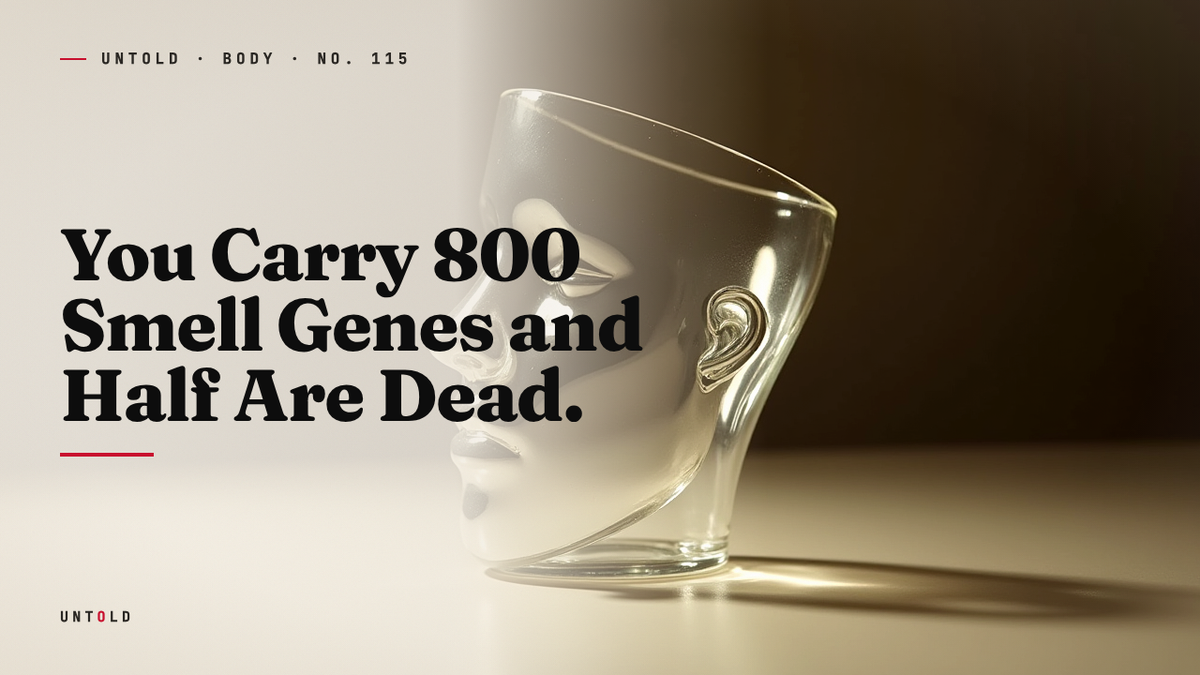
The genetic bookkeeping seems, at first, to confirm the grim verdict. Tucked into the human genome are roughly 800 olfactory receptor genes, each one a blueprint for a tiny protein designed to catch a particular family of airborne molecules. And here is the damning number: about half of them are dead. Not merely quiet. Broken. They are pseudogenes, genetic fossils, sequences so corrupted by mutation that they no longer make a functioning protein at all. Half the machine appears to be rubble.
Case closed, surely. If half your smell hardware has rotted away, you must be a poor smeller. The logic feels airtight. It is also, on inspection, one of the more durable errors in the history of biology. The count is correct. The conclusion drawn from it is almost entirely wrong. And to understand how the mistake took root and refused to die, you have to go back to a single 19th-century anatomist who was not really thinking about smell at all. He was thinking about the human soul.
A Ratio Dressed as an Anatomy
The man was Paul Broca, one of the most influential figures in the history of brain science. His name still lives in every neurology textbook, attached to Broca’s area, the patch of frontal cortex bound up with speech. He was a careful dissector and a formidable comparative anatomist. He was also, like many of his generation, deeply preoccupied with a question that today we would classify as philosophy rather than science: what separates the human animal from the beasts?
In 1879, Broca published a paper in the Revue d’Anthropologie that would cast a shadow over the study of smell for the next 140 years 1. His method was disarmingly simple. He lined up mammal after mammal and asked a single question of each brain: how large is the olfactory bulb relative to the rest of the organ? The olfactory bulb is the forward outpost of the smell system, the structure where signals from the nose first arrive in the brain. In a rat or a dog, it is proportionally substantial. In a human, set against the vast expansion of the cortex above it, the bulb looks almost embarrassingly small.
From this proportion, Broca constructed a sweeping story. He divided mammals into the osmatic, the smell-driven, and grouped humans with the primates as anosmatic or nearly so. In his telling, humans had struck an evolutionary bargain. As the frontal lobes swelled to house reason, judgment, and, crucially, free will, the nose had been allowed to wither. The mind advanced; the nose retreated. Smell was the sense of the animal, tethered to instinct and appetite; its diminishment in humans was, for Broca, a mark of our emancipation from base drives.
Notice what Broca never once did. He never tested whether a human being could actually smell. He measured a ratio, a proportion of brain volume, and let that ratio stand in for a capacity it had no business representing. His argument was, in truth, a piece of philosophy about human dignity, wrapped in the respectable clothing of comparative anatomy. The bulb was small relative to the cortex, therefore smell was weak, therefore humans had traded scent for thought. Every link in that chain was assumption, not measurement.
But Broca carried enormous authority, and the idea was flattering. It told us we had ascended above the sniffing animals. It fit neatly into a broader 19th-century project of ranking creatures on a ladder with humans at the top. So it stuck. It hardened from one man’s speculation into a fact that everyone simply knew, repeated in lecture halls and textbooks for generation after generation. The human nose was filed away as a ruin, and no one thought to ask whether the filing was correct.
The Census of the Dead Genes
For a long time there was no way to check Broca’s claim at the level of the machinery itself. Nobody knew how smell worked. That changed in 1991, when two American scientists, Linda Buck and Richard Axel, published a discovery that opened the entire black box of olfaction 2. They identified the family of genes responsible for the receptors that detect odor molecules. Each receptor, they showed, is a protein embedded in the membranes of sensory neurons in the nose, shaped to grab a particular class of molecule the way a lock accepts a key. The discovery was monumental, and it earned Buck and Axel the Nobel Prize in Physiology or Medicine in 2004.
Now, for the first time, scientists could take a full inventory. If you wanted to know how much smelling equipment a species carried, you could simply count its olfactory receptor genes. The stage was set for a proper census of the human repertoire.
That census arrived in 2003, when Yoshihito Niimura and Masatoshi Nei published their tally of the human olfactory receptor gene family in the Proceedings of the National Academy of Sciences 3. Their findings seemed, at first glance, to be Broca’s vindication written in the language of DNA. Of the human olfactory receptor genes, they counted 388 with intact reading frames, sequences still capable of producing working proteins. And they counted 414 pseudogenes: broken, silenced, disabled by mutation. More than half the repertoire, dead.
Here Broca’s ghost might reasonably have nodded in satisfaction. Compare that figure to a mouse, which carries well over a thousand functional receptor genes and a far smaller fraction of pseudogenes. On paper, the human nose looked like a species in the middle of losing its sense of smell, its genetic instruction manual crumbling page by page. Half broken. Surely, the reasoning went, that meant a feeble nose.
And yet this is precisely where the trap springs shut. The number of genes is not the same thing as the ability to smell, any more than the number of pixels on a broken half of a screen tells you how sharp the working half looks. Consider what remains after the pseudogenes are set aside: roughly 400 functional receptor types, still switched on, still producing proteins, still lining the roof of the nasal cavity. Four hundred distinct molecular detectors is not a paltry inheritance. It is an enormous one.
Because smell does not work like a set of 400 separate alarms, each tuned to a single note. Odors are read combinatorially. A single molecule activates a whole pattern of receptors at once, and the brain reads that pattern, that chord, as a particular smell. With 400 receptors combining in different proportions and intensities, the number of distinguishable patterns is astronomical. One 2014 study, controversial in its exact figure but striking in its implication, estimated that humans can discriminate on the order of a trillion different olfactory stimuli 4. Whatever the true number, the point holds. A repertoire built from 400 working parts is not a ruin. It is a combinatorial engine of staggering resolution. The dead genes were never the story. The living ones always were.
Down on the Grass at Berkeley
Still, a gene count on a page is one thing. Actual smelling is another. If humans really carry a formidable nose, the proof should show up not in a genome database but in behavior, in the crude, physical act of following a scent through the world. This is exactly the test that a group at the University of California, Berkeley decided to run in 2007, and their choice of experiment has a certain glorious absurdity to it.
Jess Porter, working in the laboratory of Noam Sobel, wanted to know whether a human being, stripped of every sense but smell, could track an odor trail across the ground the way a dog does 5. So the team took a length of twine and soaked it in chocolate essential oil. They laid it out in a zigzag across the grass of a field outside Barker Hall. Then they recruited students, blindfolded them, plugged their ears, taped over any exposed skin that might sense air currents, fitted them with kneepads and gloves, and set them down on all fours at one end of the trail. The single instruction: find the scent and follow it, using nothing but your nose.
What happened next reads like something out of a nature documentary shot on the wrong species. Two-thirds of the participants successfully tracked the chocolate trail. They dropped their noses toward the grass, they cast back and forth, and when they wandered off the scent they corrected their course and found it again. They zigzagged along the trail’s turns, following the plume of odor exactly as a tracking dog would. And when the researchers let people practice, they got faster and more accurate. The nose, it turned out, could be trained like any other instrument.
Sobel’s team went further and demonstrated that humans, like many animals, sniff in stereo. Because our two nostrils sample the air from slightly different positions, the brain can compare the signals and extract directional information, the olfactory equivalent of locating a sound by the tiny delay between two ears. This is not the behavior of a degraded, vestigial sense. It is the behavior of a working navigational tool that most of us simply never have occasion to use, because we walk upright with our noses a meter and a half off the ground and our lives arranged around eyes and ears.
The experiment did not prove that humans smell as well as bloodhounds. It proved something subtler and more important. The equipment was there all along. The capacity had never gone missing. We had just been told, on Broca’s authority, that it could not exist, and so we never bothered to look.
The Bulb Was Never Shrunken
The final blow to the century-old verdict came in 2017, and it went straight for the foundation, the very measurement Broca had built his story on. John McGann, a neuroscientist at Rutgers University, published a review in the journal Science with a title that functioned as a demolition notice: “Poor human olfaction is a 19th-century myth” 6.
McGann’s argument was devastating in its directness. Broca’s whole case rested on the olfactory bulb looking small. But small relative to what? Broca had measured the bulb as a proportion of the whole brain, and the human brain is so extravagantly enlarged in its cortical regions that almost any subcortical structure looks tiny by comparison. That is a fact about the cortex, not about the bulb. When McGann examined the human olfactory bulb in absolute terms, a different picture emerged entirely. In sheer size, the human bulb is large. More tellingly, in the actual number of neurons it contains, it falls squarely within the typical mammalian range. It holds roughly the same number of neurons as the bulbs of many species we consider excellent smellers. The bulb was never shrunken. It only appeared so through the distorting lens of a ratio, and the ratio was a red herring from the start.
McGann assembled the wider evidence too, and it dismantled the last comfortable assumption: the notion that dogs and rodents simply outsmell us across the board. They do not. The reality is that different species are tuned to different molecules. Dogs are extraordinary at detecting certain compounds, the volatile signatures of prey or explosives or disease, and their tracking ability far exceeds ours in most everyday circumstances. But for other odor molecules, humans are more sensitive, sometimes dramatically so, outperforming both mice and dogs. There is no single axis of smelling ability on which one species reigns supreme. There is only a landscape of molecules, and each nose is a map of different territory. We happen to be exquisitely tuned to the smells that mattered to a fruit-eating, socially complex primate: ripeness, spoilage, and above all, each other.
What the Nose Was Doing All Along
The strangest part of this whole affair is that the evidence against Broca was not hidden in some laboratory. It was in your daily life the entire time, running quietly beneath the threshold of awareness. The human sense of smell has been busy, and much of its work is invisible precisely because it never bothers to announce itself to the conscious mind.
Consider the intimate arithmetic of human relationships. There is a growing body of research suggesting that we read one another chemically far more than we realize. Studies have found that people can distinguish the odor of a frightened person from that of a calm one, that the sweat of someone under stress carries information others detect and respond to 7. Other work has explored how odor cues relate to the immune system, the idea that we may be subtly drawn to the body scents of people whose immune genes differ from our own, a bias that would, over evolutionary time, favor healthier offspring. Whatever the final verdict on the details, the broad point is secure: we are constantly sampling the chemical output of the people around us, and it shapes our attractions and aversions without ever surfacing as a conscious thought.
This is smell doing its oldest job. Long before it was pressed into service for savoring wine or recoiling from spoiled milk, olfaction was the sense that told an organism who and what was nearby, whether food or mate or threat. In humans that ancient function did not disappear. It went underground, folded into the machinery of emotion and social judgment, feeding the brain a stream of information we act on without ever crediting the nose. You picked your friends and your partners, in part, by how they smelled. You just never filed it that way.
Which brings us back to your wrist. That flicker of recognition, the instant certainty that the scent is you, is not a lucky trick performed by a broken organ. It is roughly 400 working receptors, reading a chord of molecules, resolving it against every other scent you have ever encountered, and returning a verdict in a fraction of a second. Half your smell genes are indeed dead, silent fossils drifting in the genome. But the half that live are doing exactly what they evolved to do, and they are very good at it. Broca looked at a ratio and saw a ruin. He was measuring the wrong thing, asking the wrong question, chasing a philosophy about the human soul through the folds of an anatomy that could not answer him. The nose was never the weak one. It was simply waiting, all this time, for someone to get down on the grass and follow where it led.

Sources
- Broca, P., “Recherches sur les centres olfactifs,” Revue d’Anthropologie, 1879. — https://gallica.bnf.fr/ark:/12148/bpt6k6564219q
- Buck, L. and Axel, R., “A novel multigene family may encode odorant receptors,” Cell, 1991. — https://www.cell.com/cell/fulltext/0092-8674(91)90418-X
- Niimura, Y. and Nei, M., “Evolution of olfactory receptor genes in the human genome,” PNAS, 2003. — https://www.pnas.org/doi/10.1073/pnas.2235141100
- Bushdid, C. et al., “Humans can discriminate more than 1 trillion olfactory stimuli,” Science, 2014. — https://www.science.org/doi/10.1126/science.1249168
- Porter, J. et al., “Mechanisms of scent-tracking in humans,” Nature Neuroscience, 2007. — https://www.nature.com/articles/nn1819
- McGann, J. P., “Poor human olfaction is a 19th-century myth,” Science, 2017. — https://www.science.org/doi/10.1126/science.aam7263
- de Groot, J. H. B. et al., “Chemosignals communicate human emotions,” Psychological Science, 2012. — https://journals.sagepub.com/doi/10.1177/0956797612445317
Related reading