The Oldest Doorway in the Brain
Why a single breath can drop you into a childhood no photograph can reach.
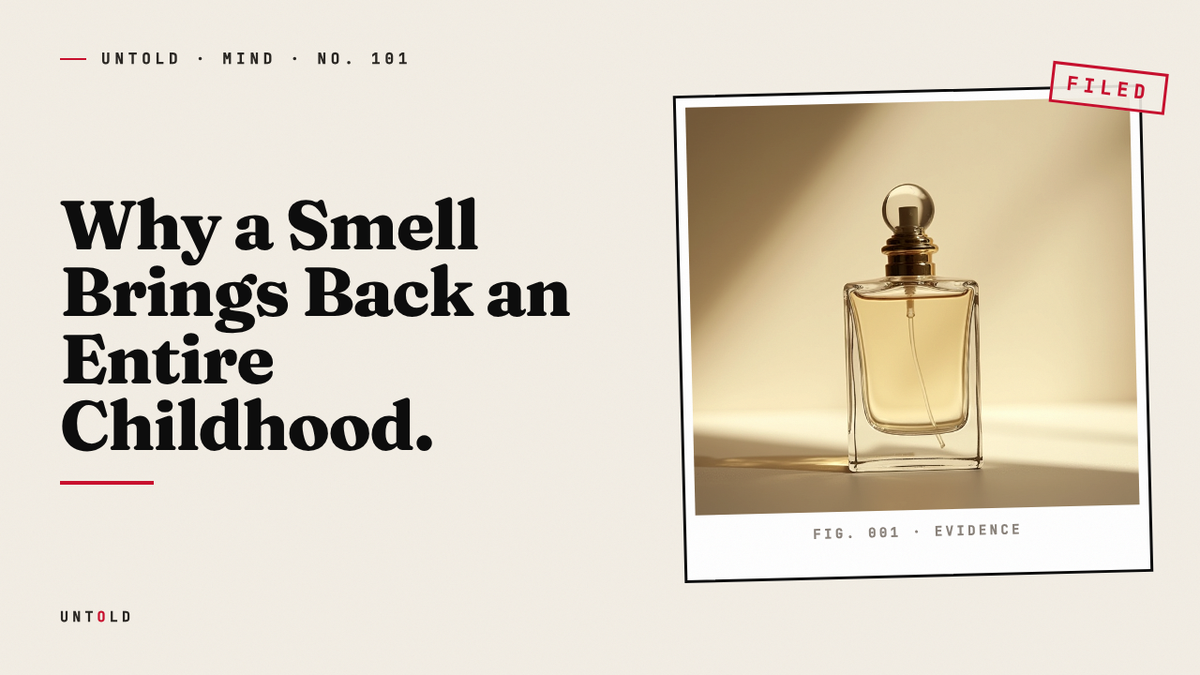
A stranger walks past wearing sunscreen, and for a fraction of a second you are eight years old again. Not remembering being eight. Being eight. There is a particular summer, a particular light, the specific smell of chlorine and hot concrete, and you are standing inside it before you can even name what you smelled. Then the world snaps back, and the stranger is just a stranger, and you are left with the strange residue of having briefly time-traveled through your own nose.
We tend to file this under a soft, forgivable word: nostalgia. A pleasant ache. A sentimental quirk of a wandering mind. But nostalgia is the wrong frame entirely, because it treats the experience as a feeling when it is really a fact of wiring. A photograph of that childhood summer would show you the past. The smell of sunscreen puts you back inside it. That difference is not poetic license. It reflects a genuine and measurable divergence in how one of your senses is built, and why it behaves like no other.
The short version is this: of all your senses, smell is the only one that skips the brain’s central switchboard and plugs directly into the machinery of emotion and memory. Every other sense checks in at a relay station first. Smell does not. That single anatomical shortcut, ancient beyond reckoning, explains why a scent can undo you in a way that a song or a photo, for all their power, cannot quite match.
The Switchboard Every Sense Must Pass
To understand why smell is the exception, you have to understand the rule it breaks. Consider what happens when you see a face, hear a voice, feel a hand on your shoulder, or taste something bitter. In each case the raw signal does not go straight to the part of your brain that experiences it. It is routed first through a walnut-sized structure buried near the center of the brain called the thalamus.
The thalamus is best understood as a switchboard, or a customs checkpoint for the senses. Signals from the eyes, the ears, the skin, and the tongue arrive there, are sorted, filtered, prioritized, and only then relayed onward to the cortical regions where conscious perception happens. Almost nothing reaches your awareness without first passing through this gate. It is one of the more reliable rules of neuroanatomy. Sight, sound, touch, and taste all obey it. 1
That routing has consequences. By the time a sight or a sound reaches the parts of the brain that feel and remember, it has already been processed, packaged, and to some extent editorialized. The signal that arrives at your emotional centers has been through a bureaucracy. It is a report about the world, not the world itself.
Smell is the one sense that refuses to file the paperwork.
The Sense That Skips the Line
When you inhale, airborne molecules drift high into the nasal cavity and land on a patch of receptor neurons at the roof of the nose. These receptors are, remarkably, the only sensory neurons in the body that sit exposed to the outside world, with one end sampling the air and the other end reaching directly into the brain. When a molecule fits a receptor, it fires a signal to a structure called the olfactory bulb, tucked just above the nasal cavity, at the very front of the brain.
And from the olfactory bulb, smell does something no other sense is permitted to do. It bypasses the thalamus almost entirely and wires straight into the limbic system, the ancient emotional and memory core of the brain. 2
The destinations matter enormously. The olfactory pathway connects, in remarkably few steps, to two structures sitting side by side. The first is the amygdala, the brain’s emotional alarm system, the region that assigns feeling and salience to experience. The second, immediately adjacent, is the entorhinal cortex, which serves as the main doorway into the hippocampus, the structure that builds and files your autobiographical memories, the story of your life.
So a smell arrives at emotion and at memory at essentially the same instant, and it arrives unfiltered. There is no relay station standing between the scent and the feeling. Every other sense meets emotion secondhand, through the thalamic middleman. Smell meets it directly, in a single synaptic hop. This is not a metaphor. It is a diagram. When people describe a smell hitting them before they can think, they are being almost literally accurate: the odor reaches the feeling regions before the reasoning regions have finished processing it. 2
A Psychologist Who Chased a Feeling
The anatomy suggests that smell-triggered memories should feel different from other memories. But suggestion is not proof. To test it, someone had to design an experiment clever enough to hold a single memory still and knock on its door in several different ways to see which knock hit hardest.
That someone was Rachel Herz, a psychologist who has spent much of her career studying the peculiar emotional physics of smell. In a 2002 study conducted with Jonathan Schooler, Herz took a careful approach. Rather than comparing different memories triggered by different cues, which would compare apples to oranges, she compared the same memory cued in different ways. 3
Volunteers first named a vivid personal memory that was tied to a particular smell. For one person it might be popcorn, for another fresh paint, for another a specific perfume. Each participant supplied a memory that was genuinely their own. Then the researchers cued that identical memory three different ways: by showing a photograph of the object, by speaking its name aloud, and finally by presenting the actual smell.
All three cues worked, in the sense that people successfully retrieved the event. The photograph reminded them. The word reminded them. They could recount what had happened either way. But the smell did something the other cues did not. When the memory was triggered by odor, people rated the experience as far more emotional and far more evocative. They reported feeling as if they had physically returned to the original scene, transported rather than merely reminded. The memory itself had not changed. Only the doorway used to reach it had. And the olfactory door opened onto a different room entirely, one with the emotional lights turned all the way up. 3
Herz’s broader work reinforced the pattern. Odor-evoked memories tend to be experienced as more vivid and more emotionally intense than memories cued by other senses, even when they are not actually more accurate in their details. The subjective sense of being there is the signature of smell. It reminds you less like a caption and more like a portal.
The Years Before Words
If smell wires directly into the emotional and memory core, and if it does so through some of the most ancient circuitry in the brain, then a further prediction follows. Smell-triggered memories might reach back further into life than memories triggered by senses more tightly bound to language, because smell was operating long before language existed, both in the history of the species and in the life of the individual child.
That is more or less what two Swedish researchers, Johan Willander and Maria Larsson, found in a 2006 study. They wanted to know not just how vivid odor memories feel, but when in a person’s life those memories tend to originate. So they took a group of older adults and cued autobiographical memories in different ways, using odors, words, and pictures, then asked when each recalled memory had taken place. 4
The results split along a revealing line. Memories triggered by words and pictures clustered in adolescence and early adulthood, the years between roughly eleven and twenty. These are the years of language, of school, of forming a self-conscious identity, the period psychologists call the reminiscence bump, when verbally encoded memories tend to concentrate.
But the odor-cued memories clustered somewhere else entirely. They peaked in the first decade of life, roughly between ages six and ten. Smell reached back into early childhood, into a period that verbal and visual cues largely could not touch. 4
This is a striking finding, and it fits the anatomy with almost suspicious neatness. The years of very early childhood are years of limited language. A young child accumulates experience long before acquiring the vocabulary to file it in words. Those early years are, for most of us, a foggy prehistory. Yet smell, which never needed words to do its work, seems to have kept a private archive from precisely that era. A scent can reach a version of you that could not yet talk, and hand back a memory that no word could ever retrieve, because no word was ever attached to it.
Older Than the Cortex Reading It
Why would evolution build a sense that flouts the rules the other senses obey? The honest answer is that it did not build smell as an exception at all. Smell is not a rule-breaker. It is the original rule.
The olfactory system is one of the most ancient sensory systems in the animal kingdom. Long before creatures could see clearly or hear or reason, they could smell. Chemical detection, the ability to sense food, mates, and danger dissolved in water or drifting on air, is among the oldest forms of perception on earth. It predates complex vision. It predates the sophisticated cortex that now sits atop the human brain interpreting the world. Crucially, it predates the thalamus as a sensory relay. 5
So when we say smell skips the switchboard, we have the story backward if we imagine it as a shortcut carved through an existing system. The truth is that smell was there first, wired directly into the survival machinery of emotion and memory, back when survival meant reacting to a chemical signal in a single decisive instant. There was no time for a committee. A smell of smoke, a smell of rot, a smell of a predator: these demanded an immediate emotional verdict, flee or approach, and the direct line to the amygdala delivered exactly that. The thalamic routing that governs vision and hearing evolved later, layered on top. Smell simply never got rerouted through it, because it had been doing its job perfectly well since before the switchboard was invented. 5
What we experience as an eerie, almost supernatural power of scent is therefore the fingerprint of deep time. The circuit that floods you with your grandmother’s kitchen is the same circuit that once told a distant ancestor, in a flash and without deliberation, that something on the wind was worth living or dying over.
The Map That Still Leads Home
This reframes the whole experience. The wiring that ambushes you with childhood was never designed for sentiment. It is a survival circuit, ancient and unsentimental, that happens to still be running under a summer afternoon. Its original job was to bind smells to feelings and to fix them in memory so that the next time that smell appeared, the right emotion would arrive instantly, before conscious thought could get in the way.
Which is precisely why grief can hide in an unwashed sweater, and why a discontinued perfume can level you in a department store aisle. These are not failures of composure. They are the system doing exactly what it evolved to do: delivering a feeling directly, without asking permission, without waiting for words, without routing the signal through the reflective, self-editing parts of the mind that might otherwise soften the blow. Smell bypasses the part of you that thinks and reaches the part of you that feels.
This also explains the peculiar quality of an odor memory, the sense that you have not so much recalled the past as fallen into it. A word-cued or image-cued memory arrives as information, mediated and labeled. A smell-cued memory arrives as experience, immediate and whole, because it takes the same direct route to emotion that it took the very first time. The door it opens is the door it always used.
So the next time a scent drags you, unbidden, into a year you had half forgotten, resist the urge to call it nostalgia. Nostalgia is a feeling you choose to indulge. This is something else: an involuntary descent through the oldest architecture in your brain, a circuit that was routing feeling and memory before your species had a face to recognize or a word to speak. It is not sentiment. It is the oldest map you carry, drawn before you could read, still quietly leading you home.

Sources
- Sherman, S. M. & Guillery, R. W., Exploring the Thalamus and Its Role in Cortical Function, MIT Press, 2006. — https://mitpress.mit.edu/9780262195324/exploring-the-thalamus-and-its-role-in-cortical-function/
- Herz, R. S., “Odor-associative learning and emotion: effects on perception and behavior,” Chemical Senses, 2005. — https://academic.oup.com/chemse/article/30/suppl_1/i250/271331
- Herz, R. S. & Schooler, J. W., “A naturalistic study of autobiographical memories evoked by olfactory and visual cues,” American Journal of Psychology, 2002. — https://pubmed.ncbi.nlm.nih.gov/11793888/
- Willander, J. & Larsson, M., “Smell your way back to childhood: autobiographical odor memory,” Psychonomic Bulletin & Review, 2006. — https://link.springer.com/article/10.3758/BF03193423
- Shepherd, G. M., “The human sense of smell: are we better than we think?” PLoS Biology, 2004. — https://journals.plos.org/plosbiology/article?id=10.1371/journal.pbio.0020146
- Herz, R. S., The Scent of Desire: Discovering Our Enigmatic Sense of Smell, William Morrow, 2007. — https://www.harpercollins.com/products/the-scent-of-desire-rachel-herz
Related reading