The Color of Salmon Comes From a Catalog
The pink on your plate was chosen off a numbered fan deck months before the fish reached ice.
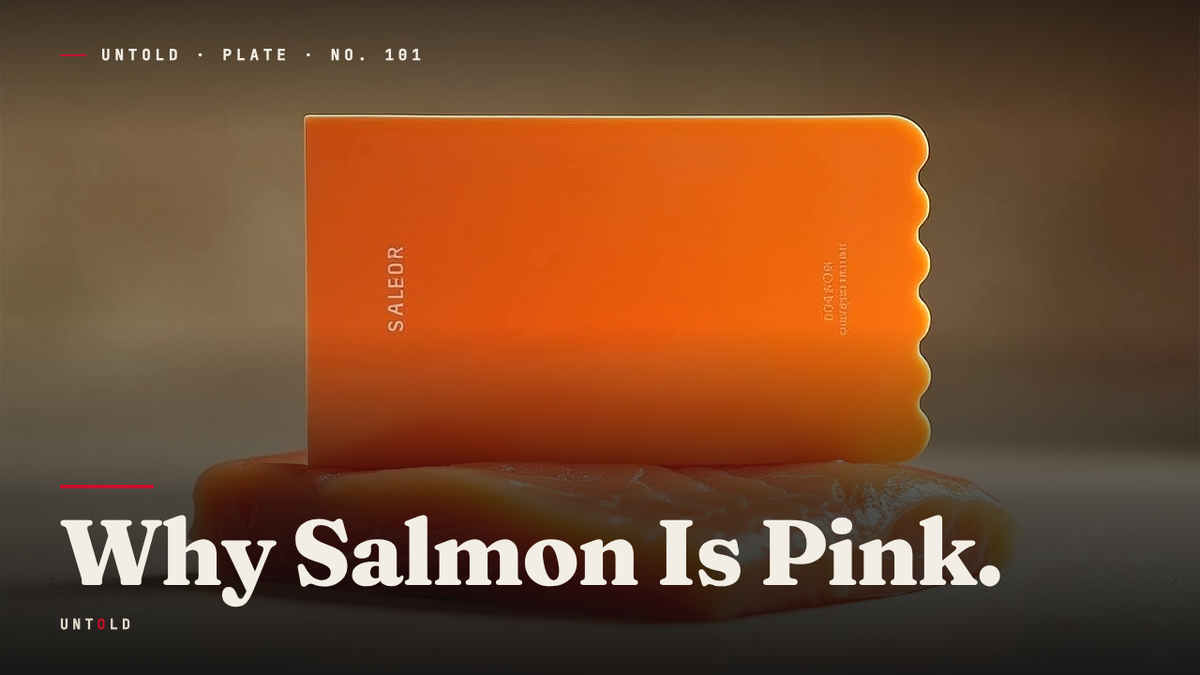
In a hatchery office somewhere along a cold coastline, a salmon farmer holds a fan of paper chips against the light. The chips are printed in graduated shades of pink, from a pale, almost apricot blush to a deep arterial coral. The fan looks exactly like the sample deck you would carry out of a hardware store to match a wall to a sofa. The farmer studies the ribbons of color, considers the market, and picks a number.
That number is the color of your dinner.
Most people move through a supermarket believing that pink is simply what salmon are, the way lemons are yellow and spinach is green. It is one of those facts that seems too obvious to question. But the flesh of a farmed salmon is not pink by default. Left to the diet it actually eats inside a sea pen, that flesh would grow up the color of a raw chicken breast: a pale, unappetizing grey. The pink is a decision. It is ordered in advance, dosed into the feed, and calibrated against a card. And for most of the salmon sold in the developed world, that is how the color arrives.
Where the real color comes from
To understand the fan deck, you have to start with the wild fish, because the entire farmed system is an attempt to imitate something that happens naturally in the open ocean.
The pigment responsible for salmon’s color is a molecule called astaxanthin. It belongs to a family of compounds called carotenoids, the same broad chemical class that makes carrots orange and tomatoes red. Astaxanthin is a particularly vivid one, a deep red that reads as pink when it is diluted through animal tissue. It is manufactured, in nature, by microalgae and phytoplankton at the very base of the marine food web. From there it climbs 1.
Tiny crustaceans eat the algae. Krill, shrimp, and copepods are dense with astaxanthin, which is why boiling a shrimp turns its shell from translucent grey to bright coral. Wild salmon spend years eating those crustaceans. The pigment they cannot use immediately gets deposited into muscle tissue, where it accumulates slowly, meal after meal, season after season. By the time a wild sockeye or king salmon reaches maturity, its flesh is saturated with the stuff, sometimes so intensely red that it looks almost unnatural to an eye trained on farmed fillets.
The mechanism is identical to the one that colors a flamingo. Flamingos are not born pink. Chicks hatch a dull grey and only develop their famous blush after years of eating brine shrimp and blue-green algae loaded with carotenoids. Take away the diet and the color fades. Zoos that feed flamingos the wrong pellets end up with pale, washed-out birds and have to supplement the feed to keep them rosy 2. In both the bird and the fish, the color is not a birthright. It is a running tally of what the animal has eaten.
This is the crucial point that the supermarket erases: color, in a salmon, is information about diet. A vivid fillet is, in the wild, a record of years spent hunting krill in cold, productive water.
The problem of the grey fish
Now put a salmon in a pen.
Farmed Atlantic salmon, which make up the overwhelming majority of the salmon eaten worldwide, do not hunt krill. They eat formulated pellets, engineered for growth and efficiency, built largely from fishmeal, fish oil, and increasingly from plant proteins like soy and wheat. These feeds are optimized to turn out a large fish quickly and cheaply. What they contain almost none of is the wild crustacean diet that delivers astaxanthin.
The consequence is unavoidable. A salmon raised on standard feed, with no pigment added, grows flesh that is pale grey. Biochemically it is a perfectly good fish. It has the same protein, the same fats, the same nutritional profile. But it is grey.
And a grey salmon is a salmon nobody buys.
This is not a small marketing inconvenience. It is an existential problem for the entire industry. Decades of experience and consumer research have made one thing brutally clear: shoppers use color as their primary proxy for quality and freshness in fish. A deep pink fillet reads as fresh, healthy, wild, premium. A pale one reads as old, sickly, or cheap, even when none of those things are true. Presented with a grey salmon fillet at the same price as a pink one, most people simply will not put the grey one in their basket. They may not even consciously register why.
So the farmed salmon industry faced a choice that was not really a choice. It could sell a grey product that consumers instinctively reject, or it could restore the color the pen had taken away. It chose to restore the color, and in doing so it turned a natural byproduct of diet into a manufactured specification.
Color, ordered by catalog
The fix arrives in the feed bag. Feed manufacturers simply add astaxanthin to the pellets, the same molecule the wild fish would have obtained from krill. Fed enough of it over enough weeks, the farmed salmon deposits the pigment in its muscle exactly as a wild fish would, and the flesh turns pink.
But here the story takes a turn away from the ocean. The astaxanthin added to most farmed feed is not harvested from krill or algae. It is synthesized in factories. For decades the trade was dominated by two chemical giants, the Swiss pharmaceutical company Hoffmann-La Roche and the German conglomerate BASF, who produced industrial astaxanthin for the aquaculture market 3. Synthetic astaxanthin is chemically near-identical to the natural molecule and far cheaper to produce than harvesting it from marine sources. There is also a natural route, derived from the microalga Haematococcus pluvialis or from certain yeasts, but it costs considerably more, so the synthetic version dominates the feed most farmed salmon actually eat.
Roche did something clever. It did not merely sell the pigment. It sold farmers a precise way to specify how much of it they wanted, and what result they should expect. That instrument was the SalmoFan.
The SalmoFan is exactly what it looks like: a fan deck of color chips, printed in a graduated series of salmon shades and numbered, in its common form, from around 20 at the pale end to 34 at the deep coral end 4. A producer picks a target number based on the market they are selling into, then adjusts the concentration of astaxanthin in the feed to hit that shade in the finished fillet. More pigment in the pellet, redder fish on the shelf. It is, functionally, a paint-matching system for living animals. The farmer chooses a swatch, and the salmon is raised to match it.
The SalmoFan formalized what had until then been guesswork. It turned salmon color into a spec sheet item, a number that could be written into a contract between a farm and a buyer, verified against a physical card, and priced. The color of the fish became a deliverable.
Why the shade is worth money
It would be easy to read all this as pure vanity, an industry fussing over a cosmetic detail. It is not. The shade is a pricing lever, and the industry knows it precisely because it has measured it.
Consumer research consistently finds that shoppers will pay more for salmon that simply looks redder, independent of any actual difference in taste, freshness, or nutrition. In controlled willingness-to-pay studies, redder fillets command a measurable premium over paler ones 5. The difference per pound can seem trivial in isolation, a matter of cents, but multiplied across the millions of tons of salmon produced globally each year, the color of the flesh translates into an enormous swing in revenue. A shade higher on the SalmoFan is money.
But that shade also costs money to produce, and this is the tension at the heart of the whole enterprise. Astaxanthin is one of the most expensive ingredients in salmon feed. By some industry estimates the pigment has historically accounted for a striking share of total feed cost, which makes it a significant line item in the economics of raising each fish 6. Every step up the color fan requires more pigment in the pellet, which means real money spent per animal.
So the farmer is caught between two forces. Push the color too pale and the fish fetches a lower price or does not sell at all. Push it too deep and the cost of pigment eats the margin. The SalmoFan number a producer selects is, in effect, the resolution of that equation, the point where the premium consumers will pay for redness meets the cost of delivering it. The color of your fillet is the visible output of a cost-benefit calculation you were never shown.
And for a long time, that calculation stayed hidden. Nobody told the shopper that the pink was purchased.
The signs at the fish counter
The reckoning, at least a partial one, came in a courtroom.
In 2003, lawyers in Seattle filed suit against several major supermarket chains over the sale of farmed salmon. The core of the complaint was simple and, once stated aloud, hard to argue with. Farmed salmon was being sold with astaxanthin added to the feed to produce its pink color, and shoppers were not being told. The fish was, in a plain-language sense, colored, and the label said nothing about it 7.
The lawsuits did not end with any finding that the pigment was dangerous, because it is not. The astaxanthin used in salmon feed is an approved additive, considered safe, and is in fact the same beneficial compound wild salmon carry. What the litigation forced was disclosure. Retailers agreed to post signs and labels indicating that the salmon’s color was added. If you look carefully at a fish counter today, you can still find that phrase, “color added,” printed in small type near the farmed salmon. It is the surviving trace of that legal fight.
It is worth being clear about what that little label does and does not mean. It is not a warning. It does not suggest the fish is unhealthy, or that the pigment is a dye splashed onto the surface like food coloring on a cake. The astaxanthin is deposited into the muscle from the inside, through diet, exactly as it would be in a wild fish. What the label tells you is something subtler and more honest: this particular shade of pink was a choice made by a producer, not an inevitable fact of the animal.
That is the real distinction between the wild fish and the farmed one, and it survives on that tiny sign. Wild salmon earn their color across years of open-ocean feeding, an accumulated record of a life spent eating krill in cold water. Farmed salmon receive their color, dialed in from a numbered card and dosed into a pellet. Both fillets end up pink. Only one of them was ever asked to be.
What the pink actually tells you
Most of the salmon eaten today is farmed, and the great majority of farmed salmon has had its color specified and delivered through feed. The flawless, uniform pink that reads to a shopper as the very picture of natural freshness is, more often than not, the least natural thing about the fish. It is the one attribute that was engineered to a target.
There is nothing sinister in this, exactly. The pigment is safe, even beneficial. The fish is nutritious. And the whole system exists only because human beings decided, without ever quite deciding it consciously, that grey fish are not worth buying and red ones are worth more. The industry did not invent our preference for color. It simply read it precisely, priced it, and learned to supply it on demand.
Still, there is a quiet lesson fanned open in that deck of chips. The pink you trust as a sign of quality is not reading you the truth of the fish. It is reading you the truth of the market: what shoppers reward, what pigment costs, where the two lines cross. The color did not come from the sea. It came from a catalog, chosen months before you stood at the counter. In the most literal sense, the color chose you before you ever chose the fish.

Sources
- Higuera-Ciapara, I. et al., Astaxanthin: A Review of its Chemical and Biological Applications, Critical Reviews in Food Science and Nutrition, 2006. — https://pubmed.ncbi.nlm.nih.gov/16431409/
- Fox, D. L., Animal Biochromes and Structural Colours, University of California Press, 1976. — https://www.ucpress.edu/
- Lorenz, R. T. & Cysewski, G. R., Commercial potential for Haematococcus microalgae as a natural source of astaxanthin, Trends in Biotechnology, 2000. — https://pubmed.ncbi.nlm.nih.gov/10740262/
- DSM (formerly Roche Vitamins), SalmoFan color standard for salmonid pigmentation, industry technical documentation. — https://www.dsm.com/anh/en_US/products/products-vitamins/salmofan.html
- Alfnes, F. et al., Consumers’ willingness to pay for the color of salmon: a choice experiment with real economic incentives, American Journal of Agricultural Economics, 2006. — https://onlinelibrary.wiley.com/doi/10.1111/j.1467-8276.2006.00915.x
- Torrissen, O. J. et al., Pigmentation of salmonids: carotenoid deposition and metabolism, Reviews in Aquatic Sciences, 1989. — https://www.taylorfrancis.com/
- Smith v. major grocery retailers, Washington State farmed salmon labeling litigation, 2003, reported in The Seattle Times and Associated Press. — https://www.seattletimes.com/
Related reading